

Hasina wasn't brought to India by its Air Force or Army: Dinesh Trivedi
Diplomatic Correspondent
Stressing that former Prime Minister Sheikh Hasina was not brought to India by the Indian Air Force or Indian Army, Indian High Commissioner to Bangladesh Dinesh Trivedi on Saturday said the legal process concerning Bangladesh’s request for her extradition is ongoing, and no timeframe can be given as courts are involved.
“To give you a straight answer, again and again, the government of India, through the Spokesperson at the Ministry of External Affairs (MEA), has replied to this that there is a process, and the process involves legality, and it is well structured. So, as far as that is concerned, the process is on,” Trivedi said.
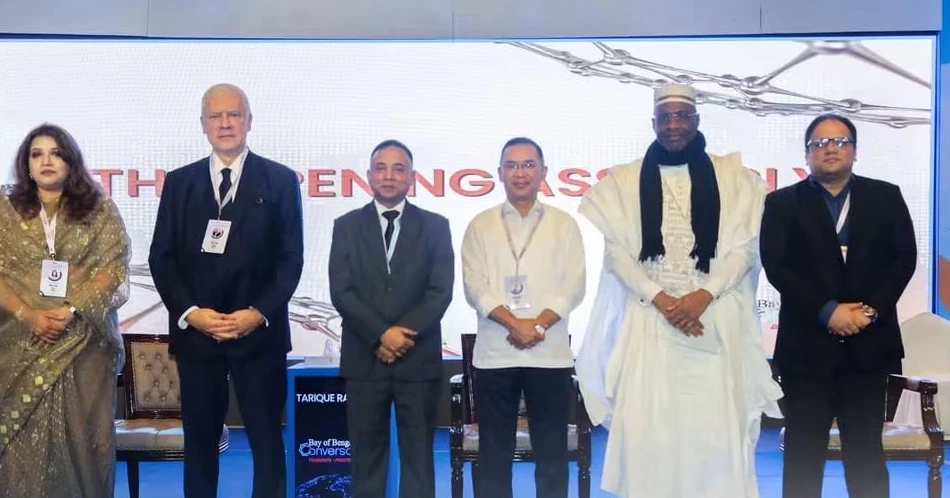
The Indian envoy made the remarks while responding to a question during a panel discussion titled "Power and Prudence: Managing Great Power Competition without Conflict" as part of the three-day Bay of Bengal Conversation that began in Dhaka.
He said the courts are involved in the matter and therefore “nobody can give you a timeframe.”
Trivedi also referred to the circumstances under which Hasina came to India after leaving Bangladesh in August 2024, saying the Indian authorities were not prepared for the situation.
“Going back to history, Hasina Ji was not brought to India by the Indian Air Force or Indian Army,” he said, referring to the circumstances surrounding her departure from Bangladesh.
He said the situation unfolded because of “tragic circumstances” in Bangladesh during that time, adding that such circumstances should never be repeated anywhere in the world where innocent people get killed - it does not matter which part of the world.
“So, the military aircraft came to India where India was not prepared. I was watching on television, and the scroll was coming that she’s going somewhere else in some other country,” he said.
Trivedi said Hasina was still the Prime Minister of Bangladesh when she arrived in India, and New Delhi had to respond to the situation as a neighbouring country.
“At that point in time, Hasina was still the prime minister of Bangladesh. We had hardly any choice on that. It was our duty as a neighbour to accept the reality of life, because situations are such where at times you are not prepared for it,” the Indian envoy said.
He questioned what India’s alternative could have been under those circumstances.
“What was our choice? If you would have said that no, we are not going to accept, we don’t give landing permission. Things would have been I don’t know what,” Trivedi said.
He, however, returned to the present legal process, stressing that India’s judicial system is functioning and that the extradition issue is being dealt with through the established process.
“The legal process is there in place, which you can be very sure of,” he said, adding that India is a “vibrant democracy,” as is Bangladesh, and that the legal system is continuing to deal with the matter.
Bangladesh has repeatedly requested India to extradite Hasina, who has been staying in India since her departure from Bangladesh in August 2024.
The issue was also raised by Prime Minister Tarique Rahman during his meeting with Trivedi in Dhaka in August.
India’s Ministry of External Affairs subsequently said that Bangladesh’s request was being examined in line with established procedures.
The discussion was organised to examine ways of managing strategic rivalry and reducing the risk of escalation amid growing geopolitical uncertainty.
President of the Bangladesh Institute of Peace and Security Studies Maj Gen (Retd) ANM Muniruzzaman, former Army Commander of the Indian Army Arun Kumar Sahni, Professor at Georgetown University Carol Christine Fair, and foreign relations adviser to the mayor of Istanbul Metropolitan Municipality Mustafa Osman Turan also participated in the discussion.
Managing Director of Cnsltng-Bsnss-Dvlpmnt, Bosnia and Herzegovina, Faris Hadrovic moderated the session.
Turan, who also served as Turkish Ambassador to Bangladesh, said strategic autonomy does not simply mean sitting in the middle.
“It means having the ability to make your own decisions in pursuit of your strategic interests,” he said.
Muniruzzaman said they live in an “extremely contested and fragmented” world and Bangladesh is playing the role of an aspiring middle power.
Arun Kumar Sahni said stability rests on two foundations - sovereignty from a military perspective, and trust.